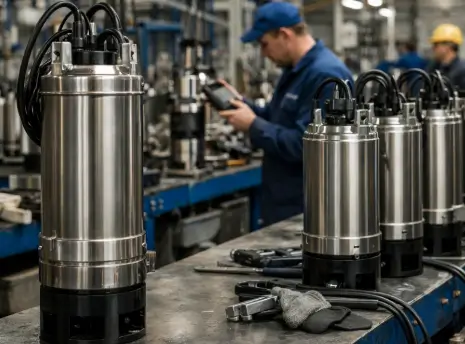
There’s a reason centrifugal pumps have been around since the 17th century and are still the go to choice across industrial operations worldwide. They’re not complicated. No valves, minimal moving parts, high flow rates, and steady output that rarely wavers. For engineers and facility managers dealing with the realities of UAE’s industrial environment, that combination of simplicity and reliability is genuinely hard to argue against.
From district cooling networks in Dubai to desalination plants feeding Abu Dhabi’s water supply, from HVAC systems inside massive commercial towers to crude oil transfer operations across ADNOC facilities, centrifugal pumps sit at the centre of it all. Most people in these buildings never think about them. The operations teams keeping those buildings running think about them constantly.
The Boost in Demand Across UAE’s Growing Industrial Base
New commercial projects, extension of industrial belts, additions of desalination capacity, and the continuing expansion of oil and gas upstream operations all demand pumping systems that are reliable in their operation under conditions that would embarrass less capable equipment.



Summer ambient temperatures in UAE industrial facilities routinely push past 45 degrees Celsius. Humidity near the coast creates corrosion conditions that eat through materials not properly specified for the environment. And the expectation of uptime is, bluntly, unforgiving. A chiller pump failing during August in a commercial tower isn’t a minor inconvenience. It’s a building evacuation situation.
This is the environment centrifugal pumps get selected for. And why getting the specification right the first time matters far more than saving a few hundred dirhams on the initial purchase.
The Mechanics Behind a Centrifugal Pump
Fluid enters the pump through the eye of the impeller. The impeller spins. Centrifugal force throws the fluid outward through the vanes and into the volute casing. The casing slows that fluid down, converting velocity into pressure. From there it exits through the discharge port and into the system.
That’s the whole story. Clean, elegant, and repeatable across millions of operating cycles without the kind of wear that more complex pump mechanisms accumulate. The fewer moving parts, the fewer things that can go wrong, which is a principle that holds up very well across decades of industrial service life.
What the Impeller Design Tells You
Closed impellers, in which the vanes are placed between two discs, are the most hydraulically efficient, and are suitable with clean liquids. Open and semi open impellers work with fluids with suspended solids, as there is no gap between the tips of the vanes and a back disc where solids can be packed together and cause blockages. Getting the impeller type wrong for the fluid being handled is one of the more common and avoidable causes of early pump failure.
Popular Centrifugal Pump Types UAE Industries Rely On
The category covers more ground than most people first expect.
Single Stage End Suction Pumps
These cover the majority of water supply, HVAC, irrigation, and general industrial transfer applications. One impeller, straightforward installation, easy maintenance access. They handle clean to mildly contaminated liquids across a wide flow range, which makes them the default choice for building services across Dubai and Abu Dhabi’s commercial developments.
Multistage Pumps
When pressure requirements go beyond what a single impeller can deliver, multiple impellers in series build pressure incrementally. Boiler feed applications, high rise building water supply, reverse osmosis pre pressurisation, these are the jobs multistage configurations handle where single stage units simply can’t develop enough head.
Self Priming Centrifugal Pumps
Standard centrifugal pumps need to be primed before starting, filled with liquid to create the suction needed to draw more fluid in. In applications where the suction source is below the pump or supply is intermittent, self priming designs remove that operational requirement. Construction dewatering, bilge pumping on vessels, and sump applications across UAE sites use these regularly.
Split Case Pumps
For genuinely large scale applications, split case designs separate the casing horizontally, giving maintenance teams direct access to the impeller and shaft assembly without disturbing the inlet and outlet pipe connections. District cooling systems, large irrigation networks, and major water treatment plants favour split case configurations for exactly this reason.
Mag Drive (Sealless) Pumps
This variant uses a magnetic coupling to transfer torque from the motor to the impeller, eliminating the mechanical seal entirely. No seal means no leak path. For chemical transfer applications involving toxic, corrosive, or valuable fluids where even a small leak carries serious consequences, mag drive centrifugal pumps are often the specification that removes the risk entirely rather than just managing it.
See also: How Wearable Tech Is Enhancing Player Performance in Golf
What Actually Goes Wrong and How to Avoid It
Cavitation is the most common cause of premature centrifugal pump failure. It occurs when the pressure at the pump inlet is lower than the vapour pressure of the liquid and vapour bubbles are formed and then burst violently against the impeller surfaces. The injury is cumulative and progressive. The sound varies, vibration is more, and ultimately the surface of the impellers seems to have been sandblasted internally.
Running a pump far outside its design operating point, usually too far toward shutoff or toward runout, does the same kind of slow damage over time. Operating near the best efficiency point isn’t just about energy savings. It’s about service life.
Why Choose Us
Advanced Flow Controls brings genuine application knowledge to every centrifugal pump enquiry. The range covers single stage, multistage, self priming, split case, and mag drive configurations across materials suited to the full spectrum of UAE industrial service, from standard water handling to aggressive chemical transfer and petroleum applications.
What separates the team from a simple product distributor is the ability to work backwards from the application. Flow rate requirements, total dynamic head, fluid properties, installation constraints, ambient conditions, and NPSH availability all factor into the recommendation before a quote is issued. Because a pump that’s technically functional but wrong for the operating conditions is only functional for a limited time.
After sales support covers commissioning, technical troubleshooting, and spare parts availability for the brands stocked. For facilities where downtime costs significantly more than the pump itself, that level of continuity in supplier relationship is what actually protects the operation.