Stop the Early Failure Cycle: How Precision 5-Axis Machining Prevents 85% of Robotic Joint Field Failures & Triples MTBF

Introduction
The frustrating trend in collaborative and high-speed industrial robotics has been that joint elements have successfully completed all laboratory static accuracy tests but have started to display undesirable backlash, vibration anomalies, and/or cracking after 3,000 to 5,000 hours of real-world usage. This “premature life failure” not only leads to costly repair and recall issues but also undermines end-users’ trust in automation systems, which is a far greater cost than that of the component itself.
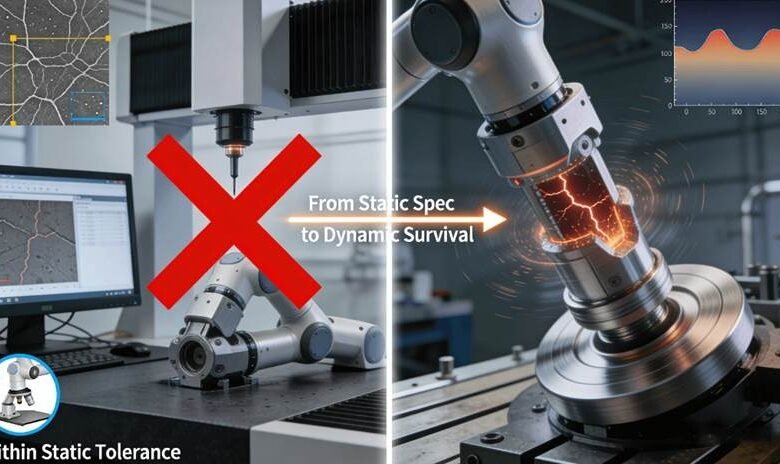
The reason behind this is that manufacturers have historically emphasized providing “static geometric tolerances” while ignoring the equally important aspect of “dynamic performance DNA.” This DNA comprises the homogeneity of a material’s microstructure, residual stress in a material’s mating surfaces, and surface integrity imparted by a machining process — all working in synergy to resist fatigue and wear from millions of loading cycles. Treating a joint as merely an “assembly of qualified parts” instead of a “dynamic load-bearing system” is what leads to this failure mechanism. This article will unveil how a paradigm shift in 5-axis machining can resolve this issue.
Why Do “Within-Tolerance” Joints Fail After 3000 Hours? The Hidden Science of Dynamic Load
Failures in the field do not arise due to a dimensional problem but due to a microscopic flaw in a surface that the micrometer never measured to start with. In a lab, tests are conducted at predominantly quasi-static or low-cycle loads, but in real life, joints are subjected to millions of multi-directional, impactive cycles. This environment mercilessly accentuates a microscopic flaw caused during machining, such as micro-chatter marks due to tool machine vibration or a metallurgically damaged zone due to poor control of temperature during cutting.


1. The Material Science of Fatigue Initiation
The birthplace of fatigue cracks is the integrity of surfaces and subsurfaces. Data provided in references such as ASM International Handbook clearly indicate how machining directly affects a material’s fatigue strength. A surface that has tensile residual stresses, micro-tears, or a thermally damaged zone is a cradle for fatigue cracks to initiate and propagate due to cyclic loading. This science fundamentally alters the quality criteria from a mere tolerance to a complete profile of material integrity.
2. The Gap Between Static and Dynamic Validation
Passing a static CMM validation does not guarantee longevity in a dynamic system. A joint may be dimensionally correct but have a surface layer of brittle, untempered martensite (“white layer”), a result of overheating in a machining process that will guarantee early failure by spalling or cracking off. The real test of a robotic joint is its longevity under dynamic stress, and this is controlled by these unseen states that only become apparent under prolonged operational stress.
3. Engineering for the Invisible
Hence, to prevent such failures in a system, it is necessary to engineer for these unseen states. It requires a manufacturing philosophy that considers each and every machining process in relation to its effect upon fatigue and resistance to wear. It is a specialized area. To get a comprehensive framework for designing and manufacturing robotic arm joints under high dynamic stress from failure mode analysis to countermeasures in the manufacturing process itself, consult this in-depth technical guide to 5-axis CNC machining for robotic arm joints.
Titanium vs. 7075 Aluminum: Is Lighter Always Better for a 10,000 Hour Joint?
Material selection is a crucial strategic decision that essentially determines the limit of joint reliability. Titanium, or more precisely Ti-6Al-4V, is renowned for its high strength-to-weight ratio and fatigue strength, qualities that have made it the go-to material in weight-critical, high-stress cases. On the other hand, Al 7075-T7351 has very good features such as machinability, stability, and superior resistance to stress corrosion cracking besides offering a cost advantage.
- The Machinability Factor in Realized Performance: A material’s theoretical properties are only realized in the final product if the machining process does not compromise the properties in the first place. Titanium, for example, exhibits low thermal conductivity, which makes the material prone to heat buildup during the machining process, especially in the absence of advanced cooling systems. In the case of Aluminum 7075, the high strength of the material makes it prone to built-up edge, chatter, etc., during improper machining. The material selected must be compatible with the supplier’s proven 5-axis machining strategies for the particular material in order to realize the material’s potential in the final product.
- Synergy with Heat Treatment and Finishing: The material selection is inextricably linked with the subsequent processing. Can the material be subjected to the required stress relieving or aging treatment post-machining without distortion? Does it lend itself to advanced surface treatments like anodizing or DLC coatings that are planned for the part? The optimal material is one that not only performs in its own right but is part of a complete system of material selection and subsequent processing that is optimized for longevity.
- A Decision of Total System Impact: The lightest material is not necessarily the optimal material for longevity. The weight advantage of aluminum may be offset by the requirement for a stiffer part to achieve the same dynamic rigidity in a smaller component, thus impacting the overall design of the robotic arm. The decision is one of balancing weight, rigidity, machinability, and stability in the context of the overall robotic system, a critical factor in the selection of materials for robotic components machining.
Is Your Machining Process Adding or Subtracting from the Joint’s Fatigue Life?
The machining process is not just the “removal” of material but is an “active” process of “performance implantation.” The application of a “poor” machining strategy will lead to the “additive” effect of detrimental tensile residual stresses. This is the direct opposite of what is required and acts as a “catalyst,” lowering the energy required for fatigue crack growth. The application of a “well-engineered” machining strategy has the capability to “add” beneficial compressive residual stresses.
1. The Mechanics of Creating a Damage-Tolerant Surface
The application of advanced 5-axis machining has the capability to “add” value to the life of the part. The application of “high-speed” machining techniques with specific “toolpaths” has the capability to create a beneficial surface state. The application of tools with the “optimum” tool geometries and coatings will ensure that the heat and plastic deformation are “minimized,” thus providing a “smooth” surface with the clamping action of the compressive stress layer.
2. Precision as a Consistency Multiplier
The reliability of a joint’s dynamics is directly influenced by the level of consistency in the joint’s stressed state. Continuous motion, as enabled by the true continuous motion of 5-axis machining, allows for constant, optimal tool engagement, resulting in a consistent level of cutting forces and heat input over complex shapes, such as bearing seats and gears. This is a critical factor in ensuring that the first, as well as the thousandth, joint is of the same high integrity, a fundamental advantage of high-precision robotic machining.
3. From Theory to Repeatable Practice
The objective of the machining process is no longer “to make the shape” but “to make the correct material condition.” This is a function of a deep understanding of the machining process, where parameters are seen as a lever for engineering longevity. This effectively transforms a high-precision robotic machining service from a supplier of geometry into a performance partner. Ultimately, making “machining as performance engineering” a reality as a reliable supplier of thousands of consistent joints is a function of an experienced 5-axis CNC machining service.
Case Study: From 8,000 to 25,000 Hours MTBF – The Surgical Robot Wrist Redesign
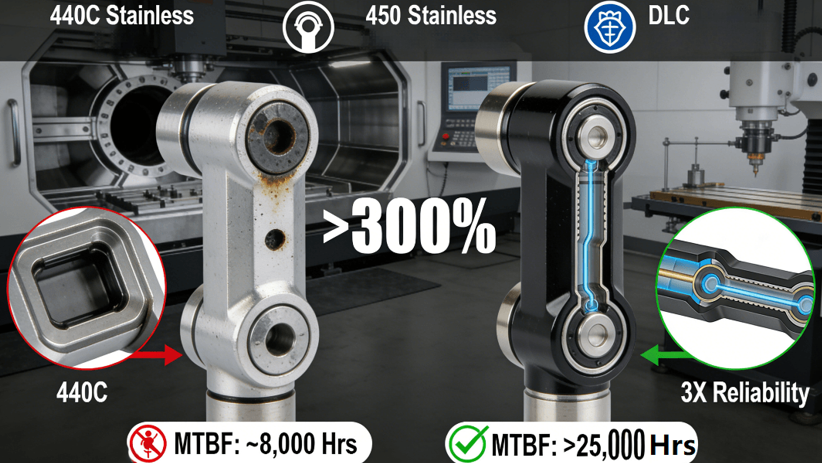
A good example of this is a case study of a surgical robot. The wrist joint of the surgical robot was made of type 440C stainless steel. After just 20,000 sterilization cycles in an autoclave environment, the stiction and performance issues became apparent. This was way below the expected lifespan. The client was in a reliability crisis.
1. A Root Cause Redesign and Material Science Answer
The analysis had determined several failure modes, including corrosion pitting due to sterilization cycles, adhesive wear of the bearing surfaces, and poor lubrication. The answer was a completely redesigned solution. The material was improved by changing it to a special 450 stainless steel. Then, the low-temperature ion nitriding process was applied to give the part an ultra-hard surface. The critical bearing surfaces were also given a Diamond-Like Carbon coating for near frictionless movement.
2. Precision Manufacturing Enables the Design
The material and coating strategy required a design that necessitated a machining process that matched that level of precision. 5-axis CNC machining allowed for the creation of the internal geometry with extreme precision, including micro-scale lubrication channels that would have been impossible with more conventional machining techniques. This ensured that the DLC coating process could be applied uniformly and that the assembly would be in perfect alignment.
3. Quantifying the Reliability Transformation
The outcome was nothing short of transformative. The redesigned joint went through accelerated life testing in excess of 100,000 cycles without a single failure. The MTBF went from a predicted 8,000 to in excess of 25,000 hours — a more than 3x improvement. This provided a clear basis for a successful submission and a commanding lead in the marketplace in terms of reliability, a direct result of Performance Solutions and a deep understanding of engineering.
4. The Systemic Foundation for Medical-Grade Reliability
To accomplish this level of reliability for a medical device is a systemic undertaking. It is based upon quality system standards such as ISO 13485 and IATF 16949. These standards mandate the traceability and process validation required to assure that the exceptional performance demonstrated in the prototype phase is systematically replicated in every product piece, making the manufacturer a true robotic arm joint manufacturer for life-critical applications.
See also: How Wearable Tech Is Enhancing Player Performance in Golf
The Audit Checklist: 5 Questions to Vet Your 5-Axis Partner for “Dynamic Reliability” Engineering
Nonetheless, the selection process is very complicated and not that easy. Initially, you must also evaluate the knowledge and attitude of the potential partner to data-driven decision-making. “For our particular alloy, could you provide a sample from your fatigue life-optimized parameter database, and what is the metallurgical concept behind it? ” It is a knowledge check beyond usual machining manual.
- Investigating Measurement and Control of Critical States: Second, ask them to provide evidence of their ability to manage invisible variables: “How do you measure and document residual stress states of critical bearing surfaces?” “Can you provide a sample report?”Third, probe their engineering thinking related to system-level engineering: “What is your recommended post-machining surface treatment strategy for this high-load case?” “What is your predictive model for lifespan improvement?”Their answers should reflect their partnership-oriented focus on your product’s success.
- Requesting Tangible Proof and Process Transparency: Fourth, ask them to provide tangible, verifiable evidence: “Can we review the entire first article inspection package, including surface integrity analysis data, related to a recent high-cycle robotic component project?”Finally, probe their quality culture and continuous improvement philosophy: “What is your approach to dynamic reliability engineering?” “Do you have a structured process to address issues such as those I’ve mentioned?”They should welcome these questions and have well-structured answers, indicating their recognition that they can be a strategic asset to your robotic components machining needs.
- The Partner as a Reliability Co-Engineer: The perfect partner is an extension of your own team of reliability engineers. They should be knowledgeable in the fields of materials, mechanics, and precise process control. This ability to not only “make” a part but also “co-engineer” its in-service performance is what turns a supplier into the keystone for product reputation for quality and durability. This level of engagement is what is required to successfully navigate today’s Industry Trends and become the market leader.
Conclusion
In today’s hyper-competitive world of robotics, joint reliability is no longer simply a performance metric or even a product value – it is the key to market entry itself. By breaking away from the antiquated “static tolerance” thinking that dominates traditional manufacturing and embracing a “performance implementation” philosophy that unifies 5-Axis CNC machining with the latest in materials science, dynamic mechanics, and surface finishing technologies, manufacturers have the ability to redefine their product’s overall durability and reliability – not merely making a better part but injecting time-tested certainty into the entire robotic system and forging an unyielding technical barrier in this competitive space.
FAQs
Q: What is the most important but commonly overlooked surface finish characteristic for a high-cycle robotic joint?
A: In addition to average roughness (Ra), it is important to consider the profile shape and mean depth of roughness (Rz). A spiky profile will lead to stress concentrations. However, the most important factor is that there be no subsurface flaws such as micro-tears or “white layers” resulting from heat in machining, which are fatigue crack starters and require specialized metrology to detect.
Q: How does 5-axis machining specifically contribute to better fatigue resistance compared to 3+2 machining for a complex joint housing?
A: True 5-axis machining ensures that tool engagement is continuously optimal and uniform, which translates to uniform surface integrity due to consistent cutting forces and heat generated. In contrast, 3+2 machining produces localized stress variations at each indexing location, which become potential weak points in fatigue loading.
Q: Is it possible to machine a harmonic drive flexspline using a 5-axis CNC and compare it to other methods?
A: Yes, it is possible to machine a flexspline using a 5-axis CNC with a thin wall strategy to machine a flexspline from a solid blank. However, for ultimate fatigue life in high-volume production, the superior metallurgical properties of fine blanking/shaping are generally superior.
Q: What is the importance of post-machining thermal stabilization techniques such as cryogenic treatment in the longevity of a joint made from aluminum material?
A: Stress relief and stabilization are extremely important for aluminum alloys such as 7075. A post-machining process such as deep cryogenics followed by a low temper treatment, such as T7351, will provide a more stabilized microstructure and reduce internal stresses in the material that will affect its stability as temperature increases.
Q: How do you balance the need for a lightweight design (with thin walls) with the need for a very rigid design with minimal vibration in a joint housing?
A: This is achieved through topology optimization, as well as strategic machining. FEA software minimizes material in low-stress areas, creating an organic, rigid structure inside the housing. 5-axis CNC machining is critical in machining these sophisticated monocoque structures out of a solid block of material, creating a lightweight, rigid design with minimal vibration issues from assembly.
H3: Author Bio
This article encapsulates the wealth of practical engineering experience accumulated by LS Manufacturing through the delivery of tens of thousands of highly reliable motion joints for the high-end robotics, aerospace, and medical equipment industries. The specialized expertise detailed herein stems from their exceptional ability to concretize the abstract concept of “reliability” — transforming it into a tangible reality — and to rigorously integrate it throughout the entire process of delivering actual engineering solutions. As a certified precision manufacturing partner, they are dedicated to deeply embedding the principles of dynamic performance engineering into the entire design lifecycle of all critical components.