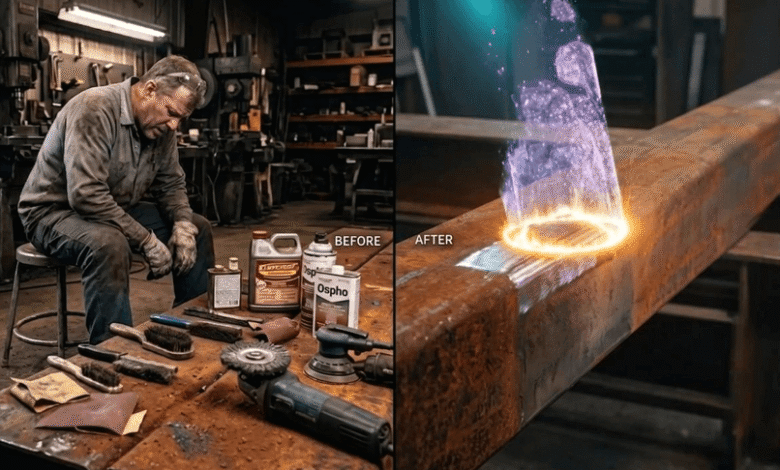
Imagine a rusted hunk of steel—twenty years of stubborn corrosion, oxide scale, and grime that wire brushes can’t even scratch. Now, watch a single beam of light sweep across it. No chemicals, no grinding, and no back-breaking scrubbing. In seconds, the metal emerges bare and gleaming.
This is the power of a modern laser cleaner. It isn’t just an incremental upgrade; it’s a category-killing shift that is rewriting the rules for workshops, shipyards, and restoration studios worldwide. Fiber laser cleaning has turned what used to be a dirty, hours-long chore into a high-tech, effortless experience.
Beyond the Wire Brush: The Industrial “Stone Age” is Over
For most of the last century, metal cleaning meant one thing: physical punishment. You scraped, you scrubbed, you sandblasted. Workers at facilities like the U.S. Steel South Works in Chicago — once employing over 20,000 people at peak — spent entire careers doing that kind of hard, repetitive surface work. The tools changed shape. The principle never did.


That era is closing.
American manufacturing has shed 5 million jobs since 2000. Factories became warehouses. Skills that took decades to build turned obsolete almost overnight. But something else happened alongside that industrial shrinkage — something the decline numbers don’t show. The technology filling the gap got a lot better.
Laser ablation cleaning is a clear example of that shift.
Wire wheels leave micro-scratches. Grinders eat through base metal. Pulsed laser cleaning removes only what doesn’t belong. The contamination — rust, oxide scale, old coatings — absorbs the laser energy. The base material doesn’t. That difference matters a great deal on a precision aerospace component or a thin panel you can’t afford to weaken.
The “Stone Age” reference in this section’s title isn’t casual. The jump from primitive tools to refined metallurgy took thousands of years in human history. The jump from wire brush to fiber laser is happening inside a single professional generation. People who learned metal prep on angle grinders are now running handheld laser cleaners that weigh under 15 pounds.
The knowledge gap is already closing. The equipment is already accessible.
What the old methods cost in time, labor, and material loss — laser derusting technology charges none of it. That’s not a small improvement. That’s a category change.
The “Magic” of Light: How One Beam Breathes New Life into Waste
Here’s the physics, stripped down to what matters.
A pulsed laser hits a corroded metal surface. It isn’t burning the whole thing. It isn’t grinding. It isn’t soaking anything in acid. The beam targets the contamination layer — rust, oxide scale, old paint, grease — with a precision no hand tool can match. The contamination absorbs the energy. The base metal underneath reflects it.
That distinction is everything.
What happens in those critical microseconds?
When the pulsed laser hits the surface, it triggers a process called Laser Ablation. The temperature in the contamination layer spikes so rapidly that the rust doesn’t just melt—it vaporizes. This creates a tiny plasma cloud and a microscopic shockwave that ejects debris away from the metal.
The “magic” lies in its selectivity: the rust absorbs the energy and vanishes, while the base metal reflects it and stays cool. You get surgical precision at industrial speeds, leaving the substrate completely intact.
Why the Substrate Stays Intact
This is the part that surprises most people the first time they see it.
Traditional metal prep methods — sandblasting, wire wheels, angle grinders — remove material without distinction. They take the contamination off, yes. They also take microns of base metal with it. On a precision aerospace component, a thin aluminum panel, or an irreplaceable cast-iron part, that material loss isn’t acceptable. There’s no way to put it back.
Laser oxide removal doesn’t have this problem. The physics won’t allow it. The contamination layer absorbs laser energy at a different rate than the clean metal beneath it. So the energy stops at the surface boundary. The rust disappears. The beam behavior shifts. You can’t overshooot and damage a laser-cleaned surface the way you can with sandpaper or a grinder.
That’s why metal restoration laser systems have become the go-to tool in aerospace maintenance, heritage conservation, and precision fabrication. A restorer working on a 1968 Mustang rocker panel gets surgical accuracy. A machinist prepping a hydraulic cylinder for recoating gets the same. Laser coating removal delivers something the wire brush never could: precise material targeting at real working speed.
The “Magic” Is Just Thermodynamics
There’s no mystery here. A beam of light turns decades of rust into bare, shining metal in seconds. That looks like magic. It’s a predictable thermodynamic process. Laser ablation cleaning works because the laws of physics favor it. Different materials absorb light at different rates. Push that gap hard enough, with a focused enough beam, and you get selectivity no mechanical tool can replicate.
That’s what a handheld laser cleaner does as it strips thirty years of corrosion in a single slow pass. Not magic. Just light, applied with enough precision to let the physics do the work.
And the physics, it turns out, is very good at this job.
The Real Math: Beyond the Invoice
Traditional cleaning hides its true cost in labor, consumables, and risk. Laser technology flips the ledger:
- Zero Consumables: No sand, no chemicals, no wire wheels to replace.
- Labor Efficiency: A job that once took a crew hours now takes one operator minutes.
- Zero Waste: No hazardous runoff or dust clouds, eliminating expensive disposal protocols.
For a typical fabrication shop, a mid-range laser system doesn’t just “pay for itself”—it often hits 100% ROI by year two. You’re not just buying a tool; you’re buying back your time and eliminating your scrap rate.
From Workshops to Galleries: The Infinite Applications of Laser Tech
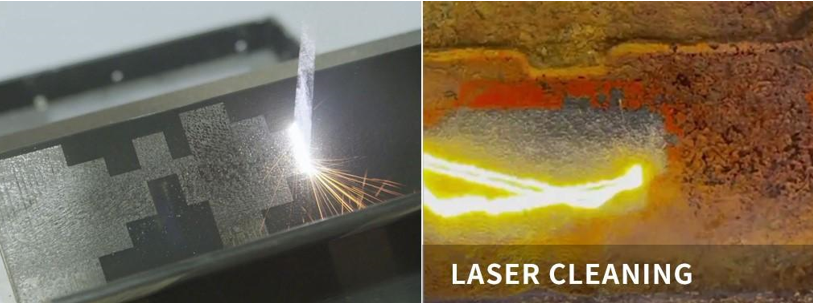
Laser cleaning started in factories. It didn’t stay there.
The core physics is simple: precise energy, selective absorption, zero contact. That same physics strips rust from a hydraulic cylinder — and works just as well in places far removed from any factory floor. Today, fiber laser cleaning and related technologies are showing up in art conservation labs, gallery installations, aerospace hangars, and atmospheric research stations. The range is hard to overstate.
What Industry Built First
Heavy industry defined the early use cases and still leads by volume. Consider what shipyards do with industrial laser cleaning: hull sections get prepped for recoating by a single operator with a handheld laser cleaner — a job that once required an entire sandblasting crew. Automotive restoration shops run laser derusting technology on frame rails, rocker panels, and suspension components. A grinder would eat into metal that can’t be replaced. Laser doesn’t.
Aerospace maintenance facilities use laser coating removal for turbine parts. These parts need micron-level precision. There’s no margin for error.
The common thread: material loss is unacceptable, and speed is money.
Non-contact metal cleaning also opened doors in telecommunications infrastructure. Tower hardware, antenna mounts, weathered junction components — electrochemical corrosion builds fast on all of them. Chemical strippers create compliance headaches. A pulsed laser system clears the oxidation cleanly, with no solvent contamination reaching sensitive signal equipment.
See also: Anti-Static Raised Flooring Solutions for High-Tech and Commercial Environments
Where the Technology Went Next
The leap to cultural and artistic applications makes sense. It’s the same selectivity, applied to different surfaces.
Museum conservators use laser ablation cleaning to lift centuries of grime from bronze statues, iron artifacts, and stone relief carvings. A wire brush on those surfaces would be catastrophic. The precision that protects a turbine blade protects a Roman-era fibula just as well. Heritage institutions across Europe and North America have built metal restoration laser systems into their standard conservation toolkit — because the physics doesn’t care whether the object came off an assembly line or out of an ancient dig site.
Artists have followed. Alex Dodge’s laser-integrated sculpture work — exhibited at the Klaus von Nichtssagend Gallery — treats the laser not as a manufacturing tool but as a creative medium. Poet-engineers working in holography draw on laser coherence properties to produce three-dimensional light displays that couldn’t exist without it. The tool shapes the art form itself.
Theodore Maiman fired the first optical laser at Hughes Research Laboratories in 1960. Sixty-four years later, the same fundamental technology is derusting steel in Milwaukee and conserving artifacts in Florence.
That kind of range — from the gritty to the sublime — belongs to very few tools in human history. Fiber laser technology earned its place in that short list.
Conclusion
The real question is no longer “Can lasers do this?”—the physics settled that years ago. The question is: How much longer are you willing to trade manual labor and chemical waste for a result that is still second-best? > Set down the grinder. Run your first pass with light. Watch the transformation in the first ten seconds, and then try to justify ever going back.