As electronic devices demand more efficient cooling, innovative solutions like oscillating heat pipes are attracting significant attention. These pipes have a unique design and excellent heat transfer ability, making them a strong solution for cooling challenges across various applications. In this article, we’ll explain what oscillating heat pipes are, how they work, and why they’re becoming so important for modern cooling systems.
What is an Oscillating Heat Pipe (OHP)?
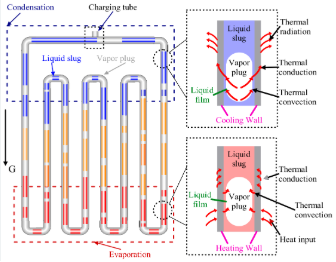
An Oscillating Heat Pipe (OHP), also known as a Pulsating Heat Pipe (PHP), is a simple and efficient device that transfers heat without pumps or external power. It consists of thin tubes arranged in a loop and partially filled with liquid. Inside the tubes, liquid and vapor form alternating sections that move back and forth with temperature changes. This oscillating motion effectively carries heat from hot areas to cooler ones.
What Makes OHPs Special?
- No Wick Needed: OHPs don’t have a wick inside like regular heat pipes. This makes them easier to build and less expensive.
- Works in Any Orientation: OHPs work effectively in any position, including zero gravity, making them ideal for space use.
- Better Heat Transfer: The liquid and vapor moving back and forth help heat move faster by constantly changing from liquid to vapor and back, and by stirring the fluid inside.
- Compact and Lightweight: They can be very thin and light, great for devices where space and weight matter.
- Can Handle High Heat Loads: OHPs can manage both low and high heat levels, making them suitable for many different cooling needs.
OHPs are a clever, adaptable, and effective way to cool things in many areas, from everyday gadgets to space technology.



Structure and Components of Oscillating Heat Pipes
1. Coiled Tube Shape
Oscillating heat pipes (OHPs) are made from long, thin tubes bent into a coil or zigzag shape. These tubes are typically 1 to 3 millimeters wide and made of copper, aluminum, or stainless steel. They’re partly filled with a special liquid called the working fluid.
2. Hot Part (Evaporator)
This part gets hot. When heat is added, the liquid inside heats up and turns into tiny vapor bubbles. This change from liquid to vapor helps move heat quickly.
3. Middle Part (Adiabatic Section)
This section is like a bridge between the hot and cold parts. The vapor bubbles travel through here without much heat change. They move toward the cooler end because of pressure changes caused by the temperature difference.
4. Cool Part (Condenser)
This is the cool end of the pipe. Here, the vapor bubbles lose heat and turn back into liquid. This releases heat and cools the system. The liquid then moves back to the hot end to start again.
5. Working Fluid (The Liquid Inside)
The liquid inside the pipe is very important. It’s often water, ethanol, or special refrigerants. This liquid needs to boil easily at low temperatures so it can quickly change between liquid and vapor. Usually, the tube is filled about 30% to 80% with this liquid.
6. Check Valves (Sometimes Included)
Some OHPs have small valves that control the direction of liquid flow. These valves help the liquid and vapor move smoothly, making cooling better, especially when the flow direction matters.
Advantages of Oscillating Heat Pipes
- Move Heat Very Well
OHPs can transfer heat quickly and efficiently, handling heat between about 20 to 100 watts easily.
- No Wicks Needed
OHPs don’t have wicks inside like regular heat pipes, making them simpler to build and more reliable with fewer parts that can fail.
- Work in Any Position
OHPs perform well in any position, even upside down or in zero gravity, making them ideal for space, airplanes, and portable devices.
- Small and Lightweight
OHPs have very small, thin channels (less than 1 to 4 mm thick), making them easy to fit into tight spaces without adding much weight.
- Can Be Built Into Devices
OHPs can be integrated directly into a device’s structure, reducing parts and weight while improving cooling reliability.
Oscillating Heat Pipes are a smart, flexible, and reliable way to cool everything from small electronics to space equipment. Their unique design gives them clear advantages over traditional cooling methods.
Challenges and Limits of Oscillating Heat Pipes (OHPs)
Oscillating Heat Pipes offer excellent cooling but require careful management of certain challenges to achieve optimal performance.
- Needs Enough Heat to Start
OHPs won’t work properly unless there’s a minimum amount of heat (usually between 5 and 15 watts). If there’s too little heat, the liquid and vapor won’t move smoothly, causing poor cooling.
- Can Struggle with High Heat
When heat exceeds 75 watts, the vapor inside the OHP moves too fast, causing “dry out.” This stops proper condensation and lowers cooling performance.
- Design Is Tricky
OHPs behave in complex ways that are hard to predict and design for. This means engineers need special computer tools to simulate how they will work, which can make development longer and more expensive.
- Material Compatibility Matters
The liquid inside must work well with the pipe’s materials. If they don’t match, chemical reactions or damage can happen, making the pipe less reliable or shorter-lived.
- Manufacturing Is Difficult
Making OHPs involves bending long tubes into complicated shapes, which can be hard to produce on a large scale. Sometimes advanced methods like 3D printing are needed, which aren’t always good for mass production.
- Orientation Affects Performance
OHPs can operate in various positions, but their cooling performance depends on orientation. If tilted unfavorably, heat transfer may decrease or stop entirely, reducing effectiveness.
Oscillating Heat Pipes are promising cooling devices, but achieving optimal performance requires careful control of heat, materials, design, and manufacturing. Addressing these challenges will expand their applications.
Conclusion
Oscillating heat pipes (OHPs) are efficient cooling devices with a unique design that enables fast heat transfer, operation in any orientation, and adaptability to varying heat loads. Their compact and lightweight form makes them ideal for use in a wide range of applications, from everyday electronics to space technology.
To maximize OHP performance, precise control of heat, materials, design, and manufacturing is essential. Overcoming these challenges will expand their use in cooling applications. Overall, OHPs are a clever, flexible, and promising way to meet today’s cooling needs with simple yet powerful technology.