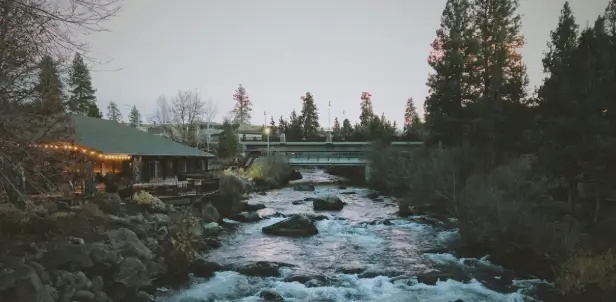
Bend sits on the dry side of the Cascades, and that single geographic fact organizes much of how litigation works here. It is the largest city in Central Oregon and the only place in the region with the full professional infrastructure a contested case requires, which makes it the default venue for proceedings originating across a wide stretch of the state. It is also a considerable drive from the federal courthouse that hears its federal matters. Working effectively in this market means understanding both realities, and NAEGELI Deposition & Trial has served Central Oregon attorneys, corporate legal departments, and government agencies with that context in mind.
What Defines Litigation in Bend and Central Oregon
Growth on a Scale That Generates Its Own Docket
Bend anchors the Bend and Redmond metropolitan area as the seat of Deschutes County, and the numbers explain a great deal about the local caseload. The city has grown from 99,690 residents at the 2020 census to roughly 109,105 in 2026, expanding at about 1.6 percent annually. Deschutes County reached an estimated 213,886 people by mid 2025 according to Portland State University’s Population Research Center, making it the second fastest-growing county in Oregon and adding more residents in a single year than Multnomah County. More than 10,000 people moved into the county between 2020 and 2024.
Growth of that kind pressures housing, and Oregon’s urban growth boundary system, established under Senate Bill 100 in 1973, constrains where development can go. Median home prices around $713,000 as of late 2025 reflect the squeeze. For litigators, this produces a distinctive body of work: land use and development disputes, construction defect claims, contractor litigation, homeowner association matters, and the employment and commercial disputes that follow a fast-expanding service economy.




A Single County District With Nine Judges
Oregon’s Eleventh Judicial District is unusual in that it consists of Deschutes County alone, and it carries nine judges. That concentration means local practice is genuinely local, with a bar that knows the bench well.
The physical courthouse has been evolving. The main building at 1100 NW Bond Street dates to 1978, while the adjoining Justice Building was constructed in 1939 and 1940, holds four courtrooms connected by a skywalk, and has been renovated repeatedly, most recently in 2021. In April 2026, the court opened an expansion exceeding 50,000 square feet, adding a new entrance and lobby, transaction windows, staff offices, four meeting rooms, and two additional courtrooms. Juvenile matters are handled at a separate facility on NW Britta Street. Deschutes County itself was created in 1916 with Bend as its seat.
Federal Matters Mean Crossing the Mountains
This is the constraint out-of-region counsel most often underestimate. The U.S. District Court for the District of Oregon maintains four divisional offices, in Portland, Eugene, Medford, and Pendleton, and the Pendleton division is not staffed, with in-person filings directed to Portland. Deschutes County falls within the Eugene Division, alongside Benton, Coos, Douglas, Lane, Lincoln, Linn, and Marion counties. Appeals run to the Ninth Circuit.
Eugene sits roughly 130 miles from Bend across the Cascade passes. In winter, those passes are a real variable rather than a rounding error. A Bend firm handling a federal matter is therefore managing a travel problem alongside a legal one, which is precisely why the ability to take testimony without moving people has outsized value here.
Resource Disputes Are Still the Regional Specialty
Bend was a mill town first. Shevlin-Hixon built on the west bank of the Deschutes in 1916 and Brooks-Scanlon followed on the east bank, and for 78 years the two dominated the local economy as among the largest pine sawmills in the world, each employing more than 2,000 workers and together producing over 500 million board feet a year. The mills closed in 1983, and the 270-acre site became the Old Mill District.
What replaced timber was tourism, recreation, healthcare, bioscience, and technology, with more than a million visitors arriving annually. But the underlying resource conflict simply changed subject. The Deschutes Basin’s irrigation districts hold water rights of differing priority dates, which means drought years distribute shortage unevenly, and junior districts absorb the worst of it. Investigative reporting in 2026 examined how Oregon water law allocates that supply across farms, ranches, estates, and destination resorts. Water rights, drought, endangered species obligations, and irrigation district governance remain live and expert-heavy areas of litigation in this region.
See also: Why Hong Kong Company Formation Continues Supporting Modern Business Expansion
What the Bend Office Provides
The NAEGELI Deposition & Trial Bend office on SW Columbia Street sits about five minutes from Deschutes Circuit Court, with large conference rooms offering complete privacy for depositions and arbitrations. Redmond Municipal Airport is roughly 25 minutes away, and the Oxford Hotel is a short drive across downtown for counsel traveling in. The firm has been setting its standard for 45 years.
Real-Time Transcription and Witness Interviews
The Bend court reporting offering covers the full arc of a proceeding, including witness interviews and real-time transcription alongside conventional deposition and hearing work. Real-time matters most in technical testimony, where an expert discussing water rights priority dates or engineering specifications can be corrected on the spot rather than after the transcript arrives. Transcripts are delivered on schedule, which in a compressed litigation calendar is not a courtesy but a requirement.
Removing the Drive Over the Passes
Having conducted thousands of remote depositions, the firm treats them as ordinary practice. Proceedings run efficiently from any location, and a personal video technician is assigned to manage and monitor each one from start to finish. In a market where the alternative may be a 130-mile mountain drive in February, this is the service that most directly changes what a case costs.
Video Edited for the Case at Hand
Certified videographers in Bend use current equipment to capture high-quality recordings of legal proceedings, strengthening how evidence and testimony are presented. Editing is done with attention to the specific needs of the case rather than to a template, and the finished deposition or recorded event can be delivered in any media format the litigation team requires.
Trial Presentation From Certified Professionals
From discovery through verdict and frequently into appeal, the trial presentation team builds computer-based courtroom presentations integrating documents, photographs, graphics, video, animation, and other exhibits, with equipment configured to the scenario. Notably, the team was among the first in the country to hold certification as Trial Presentation Professionals, which is a concrete credential rather than a marketing claim.
Documents Handled End to End
Legal document services cover copying, scanning, electronic forensics, pagination, OCR processing, Bates stamping, trial exhibit production, secure pickup, and document destruction. Resource and land use cases in this region frequently rest on decades of permits, water right records, and agency correspondence, and a document set that size is only as useful as the numbering and indexing applied to it.
Language Support in Both Directions
Legal interpreters cover more than 200 languages, including American Sign Language, across the range of proceedings and client interactions. The transcription team can also transcribe audio or video recordings in more than 200 languages, turning any trial, hearing, meeting, or recording into a certified transcript. That combination matters when a recording central to a case was never made in English.
Scheduling That Answers
Dedicated case managers are available around the clock, and scheduling is deliberately simple. In a region where a rescheduled proceeding may mean canceling travel across a mountain range, reaching someone immediately has practical value.
The Underlying Argument
Bend earns its position as Central Oregon’s legal center by being where the resources actually are. A firm serving that role well has to handle a technically demanding record, deliver it on time, and spare its clients the drive whenever the case allows it.