Anyone who has watched a conventional ride-on mower spin its rear wheels on a wet slope, or gouge a hillside on a tight turn, has already met the problem that tracked mowing was designed to solve. The traditional four-wheel machine dominates flat suburban lawns because it is cheap, familiar, and fast on smooth ground. But as soon as the terrain tilts, softens, or gets steep enough to worry the operator, that dominance evaporates. A different tool starts to make sense — one that trades top speed on flat ground for stability, traction, and the ability to keep working on surfaces that would send a wheeled mower back to the trailer. The choice between the two is not about which is better in the abstract. It is about matching the machine to the ground that will actually be under it for the next thousand hours of work.
Where Wheeled Mowers Still Win
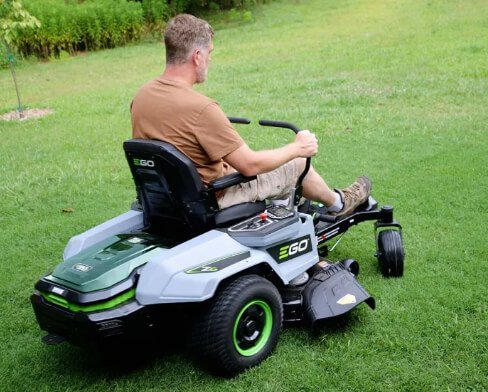
On level ground with firm turf, a wheeled ride-on mower remains hard to beat. Its speed on straight runs is higher, its purchase price is lower, and its maintenance requirements are simpler. A landscaping contractor cutting quarter-acre suburban lawns all day will get through the work faster and cheaper on wheels. The zero-turn variant compounds this advantage on properties with lots of obstacles to navigate around, because the pivot-in-place steering minimizes the time spent on transitions between passes. If the customer base is dominated by flat, dry, obstacle-heavy properties, the traditional machine is the honest choice.
The cost picture reinforces this. A commercial-grade wheeled ride-on can be purchased and maintained for roughly two-thirds of what a comparable tracked machine requires, and the used market is deeper. Financing terms tend to be more favorable because dealers understand the resale trajectory. For an operator whose work profile matches the wheeled machine’s strengths, spending more for tracks is money that will never come back.



The Terrain Where Tracks Change Everything
The conversation shifts entirely once the ground stops cooperating. Slopes above fifteen degrees are the point where wheeled mowers begin to slip, and above twenty-five degrees they become genuinely unsafe. A tracked lawn mower distributes its weight across a much larger contact patch, delivering the traction and stability that steep terrain demands. Operators who maintain golf course roughs, dam embankments, highway shoulders, ski resort slopes, or rural properties with significant grade changes discover quickly that the tracked machine is not a luxury; it is what makes the work possible at all.
Soft Ground and Ground Pressure
Slope stability is only half the story. Ground pressure — the weight the machine puts on each square centimeter of turf — is the other. Wet lawns, low-lying meadows, and freshly graded areas will not support a wheeled mower without leaving deep ruts that damage the surface and force repair work. A tracked machine with its weight distributed across two rubber tracks exerts a fraction of the ground pressure, floating over surfaces that would trap wheels. This alone justifies the tracked platform for operators who work on estates, golf courses, or municipal grounds where surface preservation is part of the contract.
The trade-off is honest: tracks are slower on hard ground, wear differently, and cost more to replace than tires. But the customers who need surface preservation and slope capability are usually willing to pay for the work in ways that quickly cover the equipment premium.
Remote-Control Models Change the Safety Calculation
The most significant category shift in recent years has been the rise of remote-controlled tracked mowers. On slopes above thirty degrees, no responsible contractor should have an operator riding the machine. The physics of rollover accidents on steep grass are unforgiving, and insurance policies increasingly reflect that reality. A remote-controlled tracked unit lets the operator stand safely uphill or across the slope while the machine works below, eliminating the rollover risk entirely.
This is not a novelty product. Municipal parks departments, highway maintenance crews, and specialty grounds contractors have moved toward remote-controlled tracked mowers as their primary tool for steep-slope work, retiring the older approach of walk-behind rotary mowers on tethers or hand-held brush cutters. The productivity difference is substantial: what took a two-person crew half a day with hand tools can be finished by one operator in an hour, and the finished surface is more uniform. Manufacturers such as MMS INDUSTRIAL have expanded their tracked mower lines specifically to serve this shift in customer expectations, and the technology is now mature enough to be treated as standard equipment rather than experimental.
Operating Cost Over the First Five Years
The purchase price comparison is misleading if it stops at the sticker. Over five years, a wheeled ride-on mower will typically consume two or three sets of tires, several belts, and multiple deck spindles. A tracked machine will consume one or two sets of tracks and fewer belts, but each track set costs more than a full set of tires. Fuel consumption tends to be roughly comparable for equivalent deck widths, though the tracked machine will burn slightly more on hard ground due to friction losses.
Downtime is where the honest comparison gets interesting. A wheeled mower stuck on a wet slope loses hours of billable time and may require a tow. A tracked mower that keeps working through the same conditions bills those hours instead of losing them. For contractors who work on marginal terrain, the difference in billable hours per season often exceeds the entire purchase price premium within two years.
Maintenance Skills the Operator Needs
Tracked machines require slightly different service knowledge than wheeled ones. Track tension needs periodic adjustment, drive sprockets wear and need replacement, and the undercarriage requires cleaning to prevent mud from packing into the rollers. None of this is beyond a mechanically confident operator, but it does require reading the manual and following service intervals. Ignoring track tension is the single most common mistake, and it accelerates wear on both the tracks and the drive components underneath.
Matching the Machine to the Work Profile
The correct choice comes from an honest inventory of the work. If less than a quarter of the properties involve significant slope or soft ground, a wheeled mower will serve better. If half or more involve these conditions, a tracked machine is the right investment. Mixed fleets are common among mid-size contractors: two or three wheeled machines for volume flat-work, one tracked unit for the specialty properties that competitors cannot handle. That combination lets the business bid confidently on any property without carrying excess equipment.
Buyers should resist the temptation to buy the tracked machine “for the one hillside property” if that property represents a tiny fraction of the work. Renting on demand is often the smarter path for occasional needs. The tracked mower earns its keep when steep or soft terrain is a regular part of the business, not an occasional exception.
See also: Website Development Services for Startups
Choosing the Right Tool for the Ground
The wheeled ride-on and the tracked mower are not competitors in the same market. They are different tools for different terrain, and treating them as interchangeable leads to mediocre results with either. Contractors who take the time to profile their actual work — the slope, the soil, the surface sensitivity of the properties they maintain — end up choosing correctly and rarely regret the decision. Those who buy on price alone or on brand loyalty often find themselves stuck on the wrong side of a wet hillside, watching billable hours drain away. The market has matured enough that both platforms are excellent within their respective domains. The decision is not which is better; it is which fits the ground you will actually be working on. Answer that question honestly, and the right machine will be obvious.