In Snohomish County, August brings a welcome stretch of brighter, drier weather before the region transitions back toward wetter conditions. For homeowners and property owners in Everett, Lynnwood, Edmonds, Mukilteo, and surrounding communities, this seasonal window is also a good time to think about what months of sun exposure can do to a flat roof.
If you are considering an inspection or concerned about the condition of an aging membrane, work with a flat roofing contractor in Snohomish County. It can help you understand whether your roof is showing normal signs of weathering or needs professional attention.
Flat roof membranes are designed to withstand outdoor conditions, including sunlight, heat, moisture, and temperature changes. However, years of repeated exposure can gradually affect roofing materials. Ultraviolet radiation, in particular, can contribute to long-term membrane weathering and changes in physical properties.




The important point is that August sunlight does not suddenly damage a roof. Instead, it adds to the cumulative environmental exposure a roofing system experiences throughout its service life. Understanding that process can help Snohomish County property owners identify potential concerns early and make informed decisions about maintenance, repair, or replacement.
Why August Sun Exposure Matters for Flat Roofs?
August is useful for evaluating a flat roof because the membrane has already experienced months of spring and summer exposure. By late summer, recurring sunlight, elevated roof-surface temperatures, temperature cycling, wind, and occasional moisture have all contributed to the season’s environmental stress.
That does not mean August sunlight suddenly causes membrane failure. Instead, late summer can make existing conditions easier to identify before Snohomish County’s wetter months return.
For property owners, the focus should be less on whether the roof has been exposed to sunlight and more on whether the roofing system is still performing as intended. Changes around seams, flashing, penetrations, drainage points, and previous repair areas can provide more useful clues than surface appearance alone.
See also: Anti-Static Raised Flooring Solutions for High-Tech and Commercial Environments
How UV Exposure Can Change a Roofing Membrane Over Time?
UV radiation is one part of the weathering process that a roof membrane experiences throughout its service life. Repeated exposure can contribute to changes in material properties, although the effect varies according to the membrane’s formulation, thickness, reinforcement, surface characteristics, and installation.
For property owners, an important distinction is that surface aging does not automatically equal membrane failure. A membrane may show changes in appearance while remaining serviceable, while problems at seams, penetrations, flashing, or other details can affect roof performance even when the main membrane surface still looks relatively good.
That is why an inspection should evaluate both the membrane itself and the components that allow the roofing system to remain watertight.
TPO, PVC, and EPDM: Why Membrane Type Matters
Property owners often hear terms such as TPO, PVC, and EPDM without knowing how they relate to roof performance.
TPO Roofing Membrane
TPO is a thermoplastic single-ply membrane commonly used on low-slope commercial and residential roofing systems. Its resistance to outdoor exposure depends not only on the fact that it is a TPO membrane, but also on the particular product formulation, thickness, reinforcement, installation quality, and detailing.
When evaluating an older TPO roof, the membrane field should not be the only focus. Welded seams, flashing, penetrations, edge conditions, and areas that have previously been repaired may reveal problems that aren’t obvious from a distance.
For that reason, property owners should avoid judging the remaining serviceability of a TPO roof based solely on color or general surface appearance.
PVC Roofing Membrane
PVC membranes are formulated to provide flexibility and resistance to outdoor exposure, but their long-term condition depends on the specific product and the environment in which the roofing system operates.
On an aging PVC roof, an inspection should consider the condition of the membrane as well as seams, flashings, penetrations, and repair areas. Surface changes can be useful observations, but they should not automatically be interpreted as evidence that the membrane has lost its waterproofing capability.
The more useful question is whether the roofing system continues to maintain the physical and watertight properties required for the building.
EPDM Roofing Membrane
EPDM is a synthetic rubber membrane commonly used on low-slope roofs. Because its material properties differ from those of TPO and PVC, its response to long-term environmental exposure also needs to be considered on its own terms.
For an older EPDM system, the inspection should consider the membrane’s overall condition along with seams, flashing, penetrations, edge details, and areas of previous repair. Age alone does not establish that replacement is necessary, just as a relatively clean-looking surface does not prove that every component remains in good condition.
The appropriate evaluation depends on the actual membrane, its installation history, exposure, drainage, maintenance, and observed condition.
UV Exposure Is Only One Part of Summer Roof Stress
Solar exposure doesn’t occur in isolation. A flat roof can experience several conditions during the same period: direct sunlight raises the membrane’s surface temperature, temperatures fluctuate between day and night, rain and moisture affect vulnerable areas, and wind can place stress on exposed components.
Drainage is particularly important. If water remains on the roof after rainfall, the issue may involve slope, drains, scuppers, or another component of the roofing system rather than the membrane itself.
This is why an August inspection should evaluate the roof as a system, not simply look for discoloration or other changes in the membrane surface.
Five Areas Worth Checking After Summer Exposure
- Seams
Seams join sections of membrane and therefore deserve close attention during an inspection. Changes, separation, or deterioration in a seam can become more important than minor cosmetic changes across the membrane field. - Flashing and penetrations
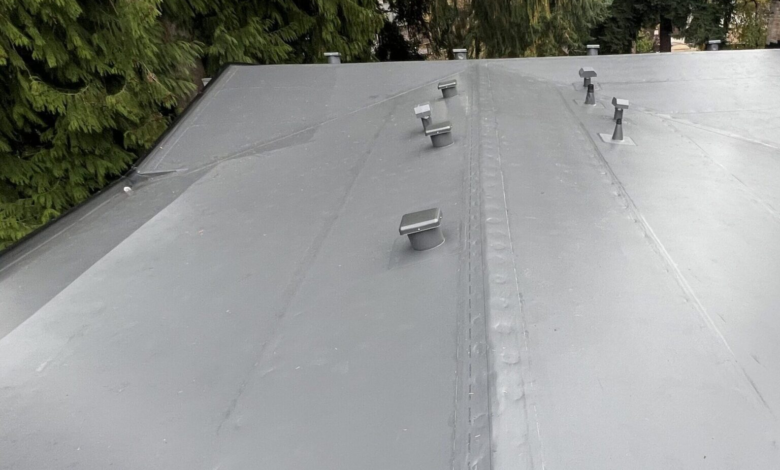
Pipe penetrations, HVAC curbs, vents, and other roof openings interrupt the membrane and require carefully detailed transitions. These locations can experience movement and weather exposure that make them important inspection points. - Drainage points
Check drains, scuppers, gutters, and other drainage components for debris or evidence of recurring standing water. A membrane can remain intact while poor drainage creates a separate roofing-system problem. - Previous repair areas
Patchwork can identify locations where the roof has experienced recurring damage or maintenance. Multiple repairs in the same area may justify a closer assessment of the underlying cause. - Roof edges and transitions
Edges and transitions connect different components of the roofing system. They deserve attention because movement, flashing conditions, and installation details can affect their long-term performance.
What Does Membrane Weathering Actually Look Like?
There is no single visual characteristic that proves a flat roof has suffered UV damage. Changes in appearance may indicate normal aging, while cracking, surface deterioration, seam problems, or damaged flashing may have several possible causes.
Property owners may notice:
- Unusual changes in surface appearance
- Localized deterioration
- Cracking or crazing where applicable
- Deteriorated seams
- Damaged flashing
- Recurring leaks
- Repeated repairs in the same area
- Conditions that appear significantly different from surrounding sections
These observations should be treated as inspection clues rather than a diagnosis. A roofing professional needs to consider membrane type, age, thickness, installation, exposure, drainage, maintenance history, and the condition of the overall roof assembly.
Why Late Summer Is a Useful Inspection Window in Snohomish County
For Snohomish County property owners, late summer creates a practical transition point for roof maintenance. The roof has already experienced months of seasonal exposure, while the drier conditions can make inspection and maintenance easier to plan before the wetter portion of the year returns.
Conditions also vary across the county. Properties closer to Puget Sound and those nearer the Cascade foothills can experience different precipitation and exposure patterns. That doesn’t mean one area automatically has worse roofing conditions than another; it means drainage, surrounding exposure, roof design, and maintenance history should be considered in context.
For a flat roof, the more useful local question is therefore not simply “How much sun did my roof receive?” but “How has this particular roofing system handled the combination of sun, temperature changes, moisture, wind, and drainage over time?”
Why Late Summer Can Be a Smart Time for an Inspection
August can offer a practical opportunity to evaluate a flat roof.
If the membrane has developed weathering, damaged seams, deteriorated flashing, or drainage problems, identifying those conditions before the wetter months can give the property owner more time to plan.
That does not mean every roof requires immediate repair.
An experienced flat roofing contractor in Snohomish County can evaluate the membrane and distinguish normal aging from conditions that warrant closer attention. A professional assessment should consider the entire roofing assembly instead of focusing on one visible defect.
For example, an inspection may reveal that the membrane remains serviceable but a drainage component needs maintenance. In another case, a localized seam repair may address the concern. An older roof with widespread deterioration may require a more comprehensive solution.
The goal is to make the decision based on evidence.
What a Useful Flat Roof Inspection Should Evaluate
A meaningful flat-roof inspection should go beyond identifying the membrane type.
The evaluator should consider the relationship between the membrane, seams, insulation, substrate, flashing, penetrations, edges, and drainage. The inspection should also account for the roof’s age, repair history, previous leaks, and any areas where water may regularly collect.
For an aging roof, it is useful to ask the inspector to explain what was observed, what requires action, and what can continue to be monitored.
That gives the property owner a more useful decision than a simple “good” or “bad” roof assessment.
How Can Property Owners Reduce Premature Roof Deterioration?
Property owners cannot eliminate UV exposure from an exposed roof membrane, and modern membranes are designed for outdoor service. The practical goal is to prevent manageable problems from accelerating the aging process.
That means:
- Keeping drains and scuppers clear;
- Addressing punctures and damaged details promptly;
- Monitoring seams and flashing;
- Limiting unnecessary foot traffic;
- Checking areas around penetrations;
- Documenting recurring leaks and repairs; and
- Following the membrane manufacturer’s maintenance recommendations.
These steps won’t stop normal weathering. They can, however, make it easier to identify problems while they remain localized and potentially less disruptive to the building.
A Roof Can Look Fine and Still Need Attention
One of the biggest mistakes property owners make is assuming that no visible leak means no roof problem exists.
Water intrusion is often a late-stage symptom. By the time a leak appears inside a building, the underlying roof condition may have existed for some time.
The same principle applies to UV exposure.
A membrane does not suddenly become compromised because August arrives. Its condition reflects years of exposure, installation quality, environmental conditions, maintenance, and material performance.
That makes professional evaluation more useful than simply waiting for a dramatic warning sign.
What Should Property Owners Check This August?
Before the wetter season arrives, property owners can make a simple visual check of accessible roof areas and document anything unusual.
Look for:
- blocked or slow-draining roof drains;
- recurring standing water;
- damaged flashing;
- visible seam deterioration;
- punctures or damaged membrane;
- deteriorated previous repairs;
- recurring interior leaks or staining.
Do not attempt to diagnose membrane failure from appearance alone. If the roof is aging, has a history of leaks, or shows changes that concern you, a professional inspection can determine whether the issue is routine maintenance, localized damage, or part of a broader deterioration pattern.
Give Your Flat Roof a Late-Summer Check
August sunlight is not automatically harmful to a flat roof. Modern TPO, PVC, and EPDM membranes are engineered to withstand outdoor exposure, including UV radiation.
The real issue is cumulative weathering.
Years of sunlight, temperature changes, moisture, wind, and other environmental conditions can gradually influence roofing materials. The way that process occurs depends on the membrane type, product formulation, installation quality, roof design, and local exposure.
For Snohomish County property owners, late summer provides a useful opportunity to assess the condition of the roof before seasonal weather changes.
If you are unsure whether your membrane is aging normally or showing signs of premature deterioration, an experienced flat roofing contractor in Snohomish County can provide a professional assessment based on the actual condition of your roofing system.
Do not wait for an interior leak to tell you that your roof needs attention. Schedule a professional flat roof inspection and have the membrane, seams, flashing, penetrations, and drainage system evaluated. A clear assessment now can help you plan maintenance or repairs before a small roofing concern becomes a costly emergency.