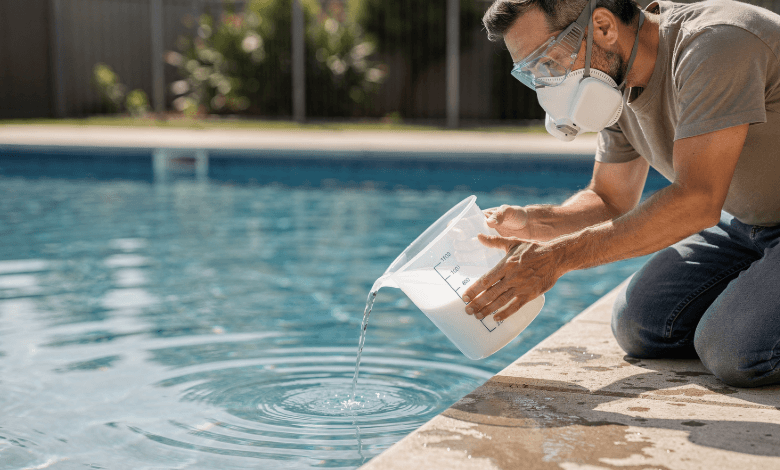
A cloudy pool after adding chlorine does not always mean something has gone wrong. Seeing a pool cloudy after adding chlorine is often a temporary result of chlorine reacting with contaminants, minerals, or particles already present in the water.
Why Pool Cloudy After Adding Chlorine Can Be Normal
Temporary cloudiness after adding chlorine can be a normal part of the sanitizing process. Chlorine reacts with algae, bacteria, sunscreen, body oils, sweat, pollen, dust, decomposing organic matter, and other contaminants in the water. As these materials are oxidized or killed, they can break into microscopic particles and residue that remain suspended until the filter captures them.
Chlorine sanitizes and oxidizes the water; it does not physically remove particles. A pool can therefore become visibly milky, hazy, or dull after treatment even though the contaminant level is falling. This commonly occurs after heavy swimming, a storm, an algae treatment, or a period of low chlorine. When comparing a salt vs chlorine pool, remember that saltwater systems also generate chlorine, so temporary cloudiness can occur with either setup.




The cloudiness is usually temporary when the water was clear before treatment, the chlorine dose was appropriate for the pool volume, the pump and filter are operating properly, the pH and other water-balance readings are within acceptable ranges, and visibility gradually improves during filtration.
Persistent or worsening cloudiness usually indicates an underlying issue such as algae, poor filtration, excessive calcium, incorrect pH, or an inaccurate chemical dose. Cloudiness that becomes denser, changes color, produces surface scale, or remains unchanged usually needs further diagnosis.
Causes Of A Cloudy Pool After Adding Chlorine
Cloudiness that appears within seconds or minutes of treatment often begins in the concentrated treatment zone. A pool cloudy after adding chlorine this quickly usually reflects a localized chemical or mineral reaction. The chlorine briefly creates conditions in that area that differ from the chemistry of the rest of the pool.
Instant white cloudiness frequently points to minerals or undissolved chemicals. Calcium hypochlorite can create a bright white cloud when the pool has elevated pH, alkalinity, or calcium hardness.
Granular chlorine can create visible specks or a localized haze while dissolving. Weak circulation, cold water, large granule piles, or an unsuitable application method can delay dispersion. Chlorine may also remain concentrated in one area when return jets are weak, the pump is off, or the pool has circulation dead spots.
Adding more chlorine than the pool requires can intensify reactions with minerals and contaminants and create visible chemical residue.
Greenish, gray, or blue-gray haze that develops after treatment is more consistent with algae or organic contamination being destroyed.
Contaminants And Cloudy Pool Water After Adding Chlorine
In many cases, cloudy pool water after adding chlorine reflects the oxidation of materials that swimmers and the environment introduce into the pool. Chlorine does more than disinfect the water; it also oxidizes these materials.
Algae can exist in the pool before the water turns visibly green. Early growth may appear as dull water, slippery surfaces, unusually high chlorine consumption, or a faint haze. After chlorine damages the algae, fragments of cell material remain in suspension. A pool cloudy after chlorine treatment may therefore be showing the residue of algae that chlorine has damaged. Dead algae often looks pale gray, blue-gray, or dusty green and may settle on the floor overnight. A large algae population can produce enough dead material to overwhelm the filter temporarily.
Dust, soil, pollen, ash, and fine landscaping debris can be smaller than the filter captures efficiently in a single pass. Chlorination may alter how these particles clump or disperse, making an existing particle load more noticeable under sunlight or pool lighting.
Body oils, cosmetics, sweat, lotions, and sunscreen increase chlorine demand and can become finely dispersed throughout the water. A heavily used pool may therefore look cloudy after treatment because the chlorine is reacting with a large organic load. Chlorine can also combine with swimmer waste to form combined chlorine compounds.
Leaves, insects, grass clippings, and other debris continue releasing dissolved organic material while they remain in the pool. Chlorine demand rises, effective sanitizer levels fall, and microorganisms may begin multiplying before the water shows obvious discoloration.
The filter must remove the physical residue left after treatment. Chlorine can kill algae and oxidize contaminants, though it does not make every particle disappear immediately. Removing debris, brushing surfaces, maintaining chlorine, circulating and filtering the water, vacuuming, and maintaining the filter complete the cleanup process. Adding repeated doses of chlorine without removing the physical residue can leave the water sanitized yet visibly hazy.
Water Balance And Pool Cloudy After Chlorine
In some cases, cloudy pool water after adding chlorine can result from high pH, total alkalinity, or calcium hardness, especially when calcium-containing chlorine is added.
When pH is high, calcium becomes more likely to leave the water and form calcium carbonate particles. These fine particles scatter light and create a white, milky, or chalky haze. The effect may become obvious immediately after adding a high-pH product such as calcium hypochlorite.
Total alkalinity influences how strongly the water resists pH adjustment. Elevated alkalinity can make the pH harder to control, support persistent pH rise, and increase the amount of carbonate available to combine with calcium.
Calcium hardness describes how much dissolved calcium is present, although clouding risk depends on the water’s overall saturation condition. When calcium hardness, pH, alkalinity, and water temperature are elevated at the same time, the risk of precipitation and scale formation increases significantly. A calcium reading that causes no problem in cool, lower-pH water may produce cloudiness after the water warms or the pH rises.
A cloudy pool after chlorine treatment is especially likely when calcium hypochlorite introduces additional calcium and raises the pH around the treatment area. Warm water and poor circulation increase the likelihood of visible clouding.
A practical target range for many traditionally chlorinated pools is approximately 7.2 to 7.6 for pH, commonly 80 to 120 ppm for total alkalinity, depending on the pool and sanitizer system, and often 200 to 400 ppm for calcium hardness in plaster pools, with lower requirements possible for some vinyl or fiberglass pools.
Exact targets depend on the pool surface, equipment, sanitizer, temperature, cyanuric acid level, source water, and local water conditions. A complete water test provides more useful information than evaluating any single reading by itself.
PHTA guidance identifies higher pH and combinations of high hardness and alkalinity as conditions that can lead to calcium carbonate precipitation, cloudy water, and scale. For residential pools, the CDC advises maintaining pH within 7.0–7.8 and following the sanitizer manufacturer’s instructions.
Chlorine Types And Cloudy Pool After Chlorine
The chlorine product can influence how and why cloudiness develops.
Calcium hypochlorite has the greatest direct potential to produce a white cloud. Granules can also remain visible when dispersion is poor.
Sodium hypochlorite, or liquid chlorine, does not add calcium or cyanuric acid and leaves no granules. It may cause a temporary local pH increase when added, although its long-term pH effect is smaller after the chlorine is consumed. A pool cloudy after chlorine treatment with liquid chlorine more often points to dead algae, an existing mineral imbalance, fine debris, contaminants, or inadequate filtration.
Dichlor dissolves relatively quickly and adds cyanuric acid with each dose. It is less likely to create calcium clouding, although repeated use raises the stabilizer level. A rising cyanuric acid level increases the amount of free chlorine required for effective sanitation, so algae and haze can develop when the chlorine level is no longer adequate.
Trichlor tablets dissolve slowly, lower pH over time, and add cyanuric acid. They are intended for controlled chlorination rather than rapid shock treatment. Inconsistent tablet delivery or long-term overuse can create low pH, high stabilizer, inconsistent chlorination, and cloudy water.
Lithium hypochlorite dissolves readily and does not add calcium, although it is less commonly used due to cost and availability.
Salt chlorine generators produce chlorine gradually while the pump is operating. Sudden cloudiness is less commonly caused by the generated chlorine itself. Scale inside the cell, weak water flow, insufficient output, or an existing algae problem may explain the timing. Manufacturers recommend maintaining proper flow, clean filtration components, and balanced water chemistry for effective generator operation.
Product quality and storage also matter. Old, damp, contaminated, or improperly stored chlorine may dissolve unevenly or provide less available chlorine than expected. Every product should be added according to its label because application methods vary.
Diagnosing Dead Algae, Chemicals, And Filtration Problems
Diagnosing a cloudy pool after adding chlorine starts with the appearance of the water, the timing of the cloudiness, test results, and filter performance.
Signs of dead algae
A cloudy pool after chlorine treatment caused by dead algae often has a uniform gray, pale green, blue-gray, or whitish haze. The pool may have been green or slippery before treatment. Dust-like material may settle overnight, collect on the floor, and form a cloud when brushed. The filter may become dirty quickly, and chlorine may continue to fall faster than expected because some algae or other organic contamination remains active.
An overnight chlorine loss test can help identify ongoing biological activity. A significant drop in free chlorine overnight, when there is no sunlight or swimmer activity, may indicate algae or another contaminant is still consuming chlorine.
See also: Lightweight Helmet Mounted Sight with Extended Battery Life
Signs of undissolved chemicals
Undissolved chlorine or balancing chemicals often appear as localized white granules, flakes, or sediment on steps and the pool floor. The cloud tends to be strongest close to the application point. This is more likely when chemicals were added with the pump off, poured into a skimmer against label directions, mixed together, or applied in cold water.
Check the product label before brushing or vacuuming concentrated deposits. Some chemicals can bleach pool surfaces, damage equipment, or react with other products.
Signs of poor filtration
A pool cloudy after chlorine may point to poor filtration when the chemistry tests correctly but the water stays hazy or shows little improvement after extended circulation. Warning signs include weak return flow, a clogged skimmer or pump basket, filter pressure outside its normal clean range, debris returning through the jets, channeling in a sand filter, torn or clogged cartridges, damaged filter grids, sand entering the pool, or inadequate daily pump run time.
A dirty filter can restrict flow. A damaged or incorrectly assembled filter may allow fine particles to pass back into the pool.
Signs of unbalanced water
Mineral-related cloudiness is usually bright white, milky, or chalky. It may appear immediately after adding calcium hypochlorite, pH increaser, alkalinity increaser, or calcium chloride and may begin around the spot where the product was added. Rough white deposits or a rising scale tendency also support this diagnosis.
Unbalanced water can produce repeatable cloudiness after chemical additions. Test free chlorine, combined chlorine, pH, total alkalinity, calcium hardness, and cyanuric acid. A single “chlorine is fine” result does not rule out algae, mineral precipitation, or stabilizer-related sanitation problems.
A professional water test can be helpful when home results are inconsistent. For saltwater pools, testing should also include the salt level.
Signs of microbubbles
Microbubbles create a sparkling white haze that is usually strongest near the return jets. A water sample clears quickly in a glass. Bubbles can result from low water level, a loose pump-lid seal, a suction-side air leak, or excessive turbulence.
Clearing A Cloudy Pool After Adding Chlorine
For a pool cloudy after adding chlorine, begin by keeping swimmers out until the main drain and the bottom of the deepest area are clearly visible and the sanitizer and pH are within the appropriate operating range. Poor visibility creates a safety risk, and chlorine may still be above the recommended swimming range.
Stop adding corrective products until the cause is clearer. Several chemicals added close together can create new precipitation, interfere with filtration, or make the original problem difficult to identify. Retest between adjustments and allow each product to circulate according to its instructions.
Run the circulation system continuously or for an extended period during cleanup and confirm that water is moving strongly through every return. Empty skimmer and pump baskets, check the water level, inspect for air in the pump, confirm that valves are positioned correctly, and position the return jets to improve movement across the surface, toward the lower areas of the pool, and through stagnant areas.
To diagnose cloudy pool water after adding chlorine, test the complete water balance accurately. Record free chlorine, combined chlorine, pH, total alkalinity, calcium hardness, and cyanuric acid. Use a fresh liquid or digital test method suitable for the expected chlorine level and follow the sampling instructions carefully. Very high chlorine can interfere with some pH tests, so follow the test-kit instructions.
Identify the cloud type before adjusting the chemistry.
Correct pH before making further large chlorine adjustments. A pH near 7.2 to 7.6 generally supports effective chlorine performance and reduces the risk of mineral precipitation.
Maintain an appropriate chlorine level. The correct free chlorine target depends partly on the cyanuric acid level. Pools with higher stabilizer require a higher free chlorine concentration to remain sanitary.
Brush the walls, steps, floor, ladders, corners, and areas behind fittings. Brushing exposes remaining algae and lifts settled particles into circulation so the filter can capture them. Vacuum settled material slowly to prevent debris from returning to suspension. Vacuuming to waste may be appropriate for a heavy layer of dead algae when the system supports it and local discharge rules permit.
Clean or backwash the filter according to its manufacturer’s pressure guidance. Rinse cartridge filters thoroughly and inspect them for tears, collapsed pleats, or poor seals. Inspect sand or diatomaceous earth filters as recommended by the manufacturer. Cleaning too frequently can reduce the ability of some filters to capture fine material, while allowing pressure to rise excessively restricts circulation.
Give the filter time to work. A cloudy pool after chlorine may clear within several hours when the cloudiness is mild. Heavy algae residue or fine mineral particles may require 24 to 72 hours of filtration and repeated cleaning.
Use clarifier only after chlorine, water balance, circulation, and filter condition have been addressed. A pool clarifier can bind very fine particles into larger clusters that the filter can capture. Overdosing clarifier can produce gummy filter deposits or create additional haze, so the label dose should be followed precisely.
Reserve flocculant for severe cases and suitable systems. Flocculant causes particles to settle on the floor and usually requires vacuuming to waste, making it unsuitable for cartridge filters or pools that cannot discharge water to waste.
Preventing Cloudy Pool Water After Adding Chlorine
Preventing a cloudy pool after adding chlorine depends on consistent maintenance that reduces the contaminant load and prevents sudden chemical reactions.
Test the water regularly and maintain free chlorine at a level appropriate for the pool’s cyanuric acid concentration. Check pH several times per week during hot weather, heavy use, or periods of frequent chemical adjustment. Maintain stable pH rather than correcting it only before major treatments. Higher pH increases calcium precipitation risk and can reduce chlorine’s germ-killing performance.
Choose the chlorine source according to the pool’s existing chemistry. Limit calcium hypochlorite when calcium hardness and scale tendency are already high. Track cyanuric acid when using dichlor or trichlor so stabilizer does not accumulate unnoticed.
Calculate doses from the pool’s actual water volume. Dimensions, average depth, steps, benches, and irregular shapes can make the stated pool capacity inaccurate. A dosing error of 20% produces the same percentage error in the intended chemical change.
Add chemicals separately and allow adequate circulation between products. Follow each label’s instructions concerning dilution, application location, pump operation, brushing, and waiting periods. Pre-dissolve a product only when its label specifically permits it. Never mix different chlorine products or combine chlorine directly with acids, algaecides, or other pool chemicals.
Keep the filter operating long enough to circulate the full pool volume effectively. Establish the filter’s normal clean pressure and investigate meaningful changes. Clean or backwash the filter when indicated by pressure changes and manufacturer recommendations. Inspect cartridges, grids, seals, laterals, valves, baskets, and return flow as part of routine maintenance. A pump that is running can still provide inadequate filtration when flow is restricted or water is bypassing damaged filter media.
Remove leaves, insects, and organic debris promptly, brush low-circulation areas, vacuum routinely, and clean the waterline. Ask swimmers to shower before entering; even a brief shower removes dirt, sunscreen, body oil, sweat, cosmetics, and other substances that would otherwise increase chlorine demand and burden the filter.
Test after storms, pool parties, heat waves, major water additions, visible algae growth, and long periods with the cover closed. These events can change chlorine demand, pH, temperature, dilution, and contaminant levels quickly. Early correction requires less chlorine, places less strain on the filter, and prevents the large chemical swings most likely to reveal themselves as prolonged cloudiness after treatment.