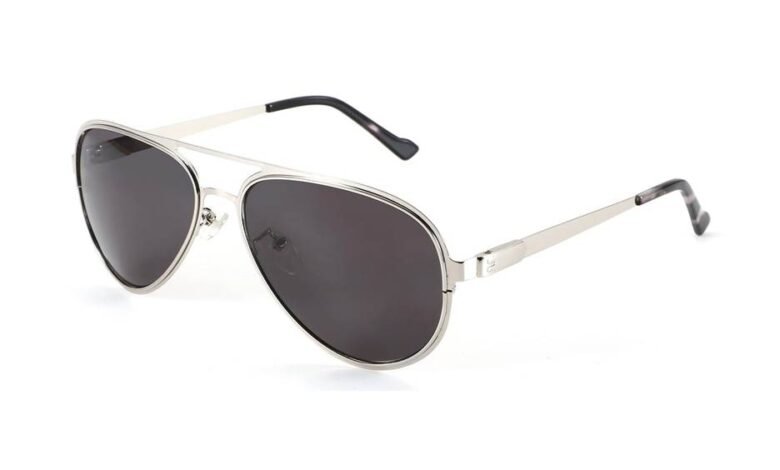
Few eyewear shapes have lasted as long as the aviator. It was drawn for a specific job, protecting pilots’ eyes at altitude, and the design worked well enough that it left the cockpit and never went back. Nearly a century later the same silhouette appears on drugstore racks and in glass display cases, which is part of the problem. When a shape gets copied that widely, the differences that actually matter tend to disappear under marketing language.
This piece strips the frame back to its working parts. What the teardrop lens is doing. Why there are two bridges instead of one. How the geometry interacts with different faces, and where it commonly goes wrong. Which lens treatments change what you see, and which only change how you look to other people. And how to judge, standing in front of a mirror, whether a pair genuinely fits your head or is simply resting on it.
No trend forecasting, no styling rules about what you can and cannot wear. Just the parts of the decision that affect your vision and how the frame feels after an hour on your face.




A Shape With a Reason
The aviator was never a fashion exercise. Early pilots flew in open cockpits wearing goggles that fogged over, cracked in the cold, and left blind spots at the edges. The design brief was almost entirely practical: cover as much of the eye socket as possible, block light arriving from above and below, stay light enough to wear under a leather helmet for hours, and leave the instrument panel visible when the wearer glanced down.
Every signature feature traces back to one of those constraints. The elongated lens extends the downward field of view. The thin metal rim keeps weight off the nose across a long flight. The wire temples hook behind the ear so the glasses stay put through hard maneuvers. What reads today as styling, the slight downward sweep of the lens and all that exposed hardware, is really the leftover evidence of engineering decisions made for a specific working environment. That functional origin is why Aviator Sunglasses have outlasted almost every trend that came after them. A shape solving a real problem tends to age better than one chasing a season.
The Parts That Define the Frame
Strip away color and finish and an aviator comes down to three structural elements. Understanding what each one does makes it much easier to tell a well-executed pair from a shape that merely borrows the outline.
See also: The Digital Shift Transforming Fashion Retail Experiences
The Teardrop Lens
The classic lens is wider at the top than at the bottom, with the lower edge curving inward toward the cheek. This is not decoration. The width up top shields the brow line, where glare usually enters, while the taper below keeps the frame off the cheekbone so it does not smear or catch during expression. Copies often get the proportion wrong, either flattening the curve into something closer to a rectangle or exaggerating the drop until the lens sits on the face. Both versions look approximately right in a product photo and feel wrong once worn.
The Double Bridge
That second bar across the top serves a real structural purpose. Metal aviator frames are thin by design, and a single bridge on a lens that wide would flex every time the glasses were handled, gradually pulling the lenses out of alignment. The upper bar triangulates the front and holds the two rims parallel. On heavier acetate interpretations the second bridge is sometimes purely cosmetic, which is worth knowing rather than worth objecting to.
Bayonet Temples
Traditional aviators use straight temple arms that slide along the top of the ear rather than curving down behind it. The original reason was headgear clearance, since a hooked temple fights with a flight helmet. The practical consequence today is that fit depends heavily on temple length and on how much tension the arms apply at the sides of the head. Too short and the frame slides forward. Too long and it pivots. Many modern versions swap in a curved, coated tip, which trades a little authenticity for noticeably better grip.
Matching the Frame to Your Face
The usual advice reduces to a chart pairing face shapes with frame shapes, and it is not entirely useless, but it skips the mechanics. Aviators have strong horizontal width at the brow and a narrowing base, so they add visual breadth up high and draw the eye downward. That single tendency explains most of what the charts assert.
On a square or angular face the curved lens edges soften a strong jaw, which is why the pairing is so often recommended. On a round face the effect depends almost entirely on lens size, since an oversized pair widens the face further while a moderately sized one provides useful contrast. Heart-shaped faces generally do well, because the taper at the bottom of the lens echoes a narrower chin. Long or oval faces have the most latitude, though a very deep lens can stretch the proportions further.
Two measurements matter more than any of this. The frame should be roughly as wide as your face at the temples, with the hinges sitting at the outer edge of your head rather than pinching inward or hanging past it. And the top rim should follow your brow line without covering it, while the bottom edge clears your cheek when you smile. Get those right and the face-shape question mostly resolves itself.
Lenses: What Changes Vision, What Changes Looks
Lens choice is where the largest functional differences live, and also where the most confusion is generated. Two things are non-negotiable and unrelated to appearance: full ultraviolet protection and optical clarity. A dark tint provides no ultraviolet defense on its own, and a cheap lens can distort geometry enough to cause eye strain over a long day. Neither property is visible by looking.
Beyond that, the meaningful options are fairly short. Polarization filters horizontally reflected light, which cuts glare off water, wet roads, and snow, at the cost of making some digital screens and instrument displays hard to read at certain angles. Mirror coatings reduce the total light reaching the eye and are genuinely helpful in high-altitude or open-water brightness. Gradient tints, dark at the top and clearing toward the bottom, suit driving because they shade the sky while leaving the dashboard legible.
Tint color has a subtler effect than most people expect. Grey preserves colors most accurately and is the safest general choice. Brown and amber lift contrast, which helps in overcast or variable light. Green sits between the two. Anything more saturated is a stylistic decision, not a performance one, and there is nothing wrong with treating it that way as long as you know which you are buying.
Checking the Fit Before You Commit
A five-minute test in front of a mirror catches most problems. Put the frame on without adjusting it and look straight ahead. The lenses should center on your eyes horizontally, with your pupils sitting slightly above the midline of each lens rather than dead center. Then lean forward and look at the floor. A well-fitted pair stays put; if it slides down your nose, the bridge is too wide or the nose pads need adjusting. Turn your head sharply side to side and watch for the same movement.
Next, check the contact points. The weight should rest on your nose, distributed across the pads, with the temples merely stabilizing rather than clamping. Pressure at the sides of your head means the frame is too narrow, and it will produce a headache within an hour. A gap between the temple and your head means the opposite. Finally, smile widely and confirm the lower rim does not touch your cheeks, since that contact leaves marks and pushes the frame out of position every time your face moves.
Materials and Longevity
Traditional aviators are metal, and the specific metal determines most of the ownership experience. Stainless steel resists corrosion and takes daily handling well. Titanium is lighter and hypoallergenic, which matters on a frame designed to rest its full weight on the nose. Monel and other base-metal alloys are common at lower price points and generally serviceable, though plating wears through at contact points over time and some wearers react to the nickel content.
The parts that actually fail are rarely the ones people inspect. Hinges take the most stress, spring-loaded ones absorb flex better than plain barrel hinges, and screws work loose long before anything else breaks. Nose pads harden and yellow with skin oil and sun exposure, but they are usually replaceable, which extends a frame’s life considerably. Brands specializing in the category, ZENOTTIC among them, tend to treat these components as serviceable rather than sealed, and that distinction is worth checking before buying anything you intend to keep.
Where People Go Wrong
The recurring mistakes cluster into a short list, and all of them are avoidable:
- Buying on lens darkness instead of verifying ultraviolet protection
- Choosing a size from photographs rather than from temple-to-temple width
- Assuming polarization is universally better, including for driving with certain displays
- Ignoring nose pad adjustability on a frame that carries its weight there
- Treating the shape as one-size-fits-all when lens depth varies enormously between versions
What connects them is a habit of evaluating the frame as an object rather than as something worn. The aviator is a well-solved design, but the solution only holds if the proportions match the head it sits on.
Function First, Everything Else After
The aviator has survived because it was built to do a job, and the features that make it recognizable are the same ones that make it work. The wide upper lens blocks light where light actually arrives. The taper keeps the frame clear of the cheek. The second bridge holds thin metal in alignment. Once you can see the reasoning behind each element, judging a particular pair becomes far less mysterious.
Two checks carry most of the weight. Confirm the lens offers full ultraviolet protection and distortion-free optics, neither of which is visible to the eye and both of which affect how your eyes feel at the end of a long day. Then verify the fit: frame width matching your temples, weight sitting on the nose pads, no contact with your cheeks when you smile, no pressure at the sides of your head. Everything else, tint color, finish, lens size within a reasonable range, is preference rather than performance.
Choose on those terms and the shape does what it has done since the beginning. Get them wrong and no amount of heritage makes an ill-fitting frame worth wearing.